Short answer
Faith comes primarily from holding a weekly Mass once the Temple is available. The size of each payout scales with four things you control: the Temple's Splendor, the congregation's Gratitude, the quality of the Prayers you craft at a Writing Desk, and Theology-related perks you unlock.
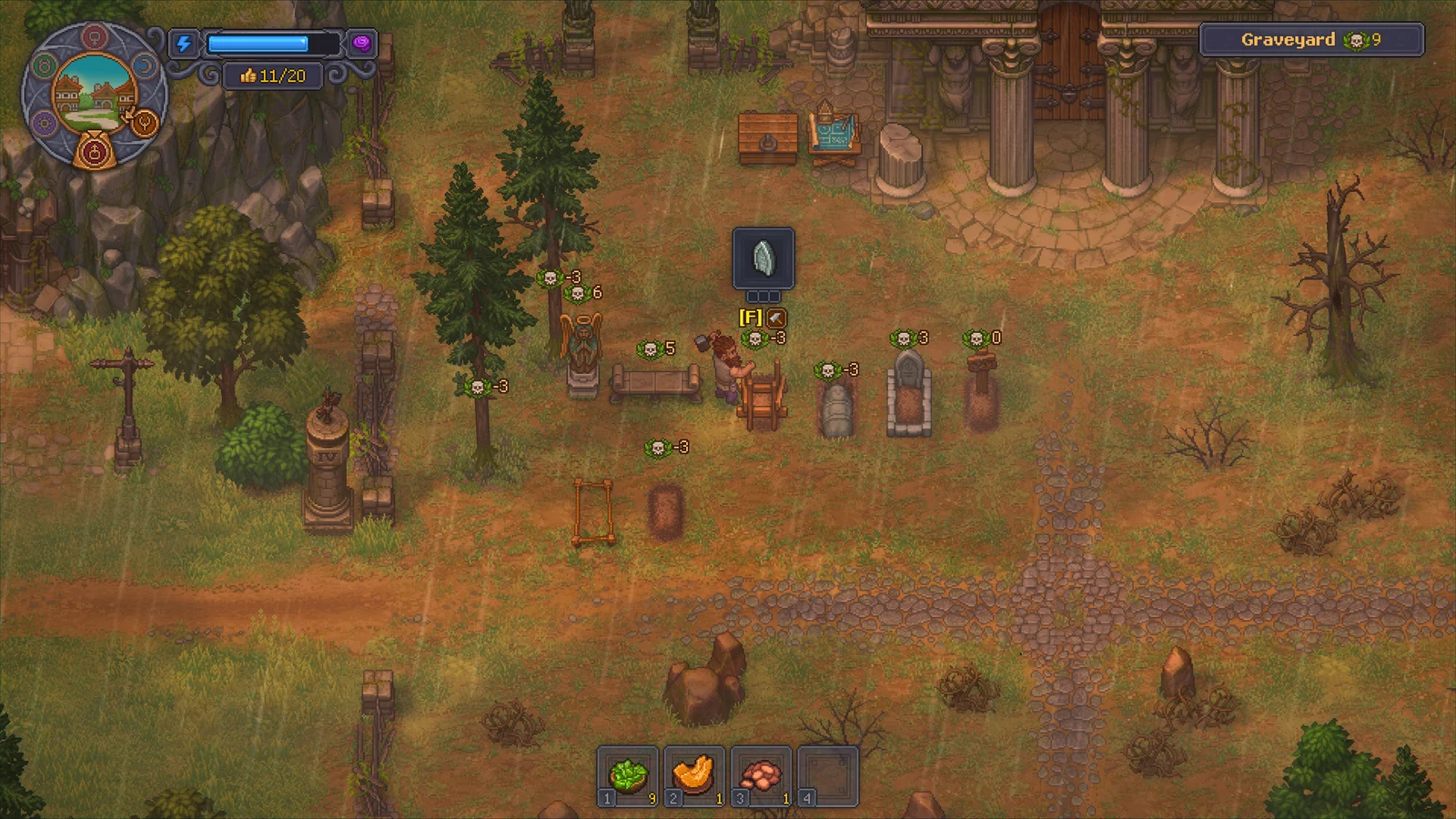
The graveyard
View full-size image ↗Official promotional screenshot · © Lazy Bear Games / tinyBuild · Official media kit · Material credits
Unlock the church first
Faith cannot be accumulated until you have progressed the main story far enough to unlock the church and its Temple functions.
This is the most common reason a new player cannot find a Faith meter: the system simply is not open yet.
The church itself is handed to you as part of your role. As the developers put it, you get your house, church and graveyard just for being a decent person — the Town is the part you have to fight for.
Weekly Mass is the main source
Once the Temple is available, performing weekly Mass becomes your primary source of Faith.
Because it is weekly, it belongs in your day planning alongside the other mechanics tied to specific days of the week.
Missing the day means missing that week's Faith income, so it is worth building your schedule around it.
Four levers that raise the payout
Temple Splendor is the first lever — a better-appointed temple yields more Faith per sermon.
Gratitude is the second: keeping your congregation satisfied raises what you receive.
The third and fourth are craftable and permanent respectively — better Prayers, and Theology-related perks unlocked through progression.
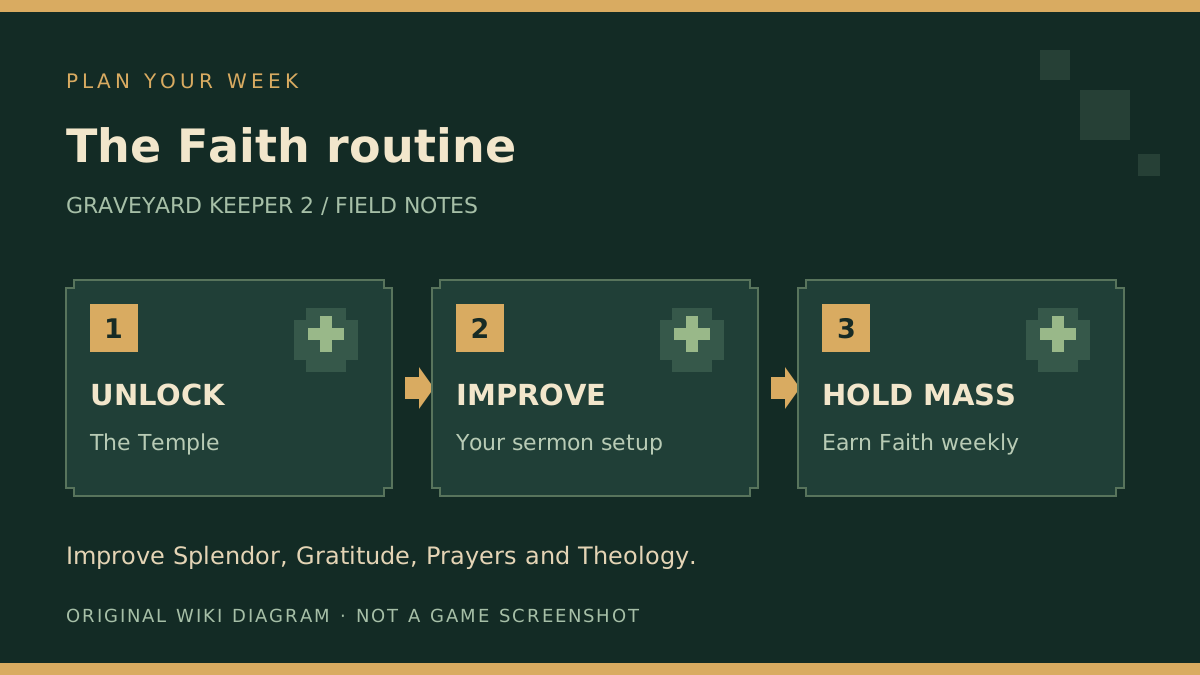
An original summary of the Faith routine described above, not an in-game screen or a numerical payout formula.
View full-size image ↗Original diagram · Graveyard Keeper 2 Wiki · editorial illustration · Original wiki diagram
Prayers are crafted, and they do more than Faith
Prayers are made at Writing Desks rather than bought.
Beyond increasing the Faith a sermon generates, prayers grant various buffs of their own.
That makes the Writing Desk a genuine production building rather than a one-off quest prop, and worth slotting into your base layout early.
How Faith connects to the rest of the game
Faith behaves as a soft currency for faith-aligned progression rather than something you spend at a shop.
In the first game, research at the Study table consumed both Science and Faith, with Faith earned through sermons and the confessional — the sequel keeps that shape of sermon-driven faith economy.
Because the systems overlap, sloppy graveyard work has knock-on effects: burying low-quality bodies drags your graveyard rating down and slows the faith-side content that depends on it.
Practical routine
Treat Faith as a weekly harvest: improve the Temple and your prayer stock between sermons, then collect on the designated day.
Prioritise upgrades that raise Splendor and keep Gratitude high, since those multiply every future sermon rather than paying out once.
And keep processing corpses properly — removing corrupted organs before burial is what keeps the graveyard side of your rating healthy.
Building the temple that pays you
Splendor is the property that turns a modest sermon into a profitable one, so improving the temple is the highest-leverage faith investment.
Gratitude behaves like goodwill and has to be maintained rather than bought once.
Theology-related perks are permanent multipliers on top, which makes them worth prioritising over one-off gains.
Together these four levers mean two players holding the same weekly Mass can receive very different amounts.
Prayers are a production line
Because prayers are crafted at Writing Desks, faith income depends on a workbench like any other resource.
Better prayers raise the faith a sermon yields, and they also grant assorted buffs when used.
That gives the Writing Desk a permanent place in your base layout rather than a temporary one.
It also means paper-side materials deserve room in your storage planning alongside wood and metal.
Faith sits inside the weekly rhythm
Mass is weekly, and city battles run on their own fixed day, so two of your most valuable activities are calendar events.
Planning the week around them — production days feeding fixed days — is the practical way to keep both fed.
Quest characters now stay at their usual locations rather than visiting once a week, but some of their mechanics remain day-locked.
Fast travel via Milestones between unlocked locations is what makes that schedule workable.
How faith relates to the graveyard
Your role bundles the church and the graveyard together, and the two sides of the job share a reputation.
Burial rating is driven by corpse quality, scored as white skulls minus red, with corrupted organs removed during autopsy to raise the net figure.
Sloppy burials therefore drag on the same religious standing your sermons build.
Meanwhile a larger, more prosperous Town sends more and better corpses, so town rebuilding indirectly improves both sides.
What is not documented yet
No first-party source publishes exact faith values per sermon, per Splendor level or per prayer type.
The first game's study table consumed both Science and Faith for research, and sermons and the confessional supplied the faith — the sequel keeps that shape.
But numbers from the original should not be assumed to carry over, so this page avoids quoting them as if they were current.
Verified sequel values will be added here as they are confirmed.
Common reasons your faith is not moving
The most frequent cause is simply not having reached the point where the church and its Temple functions are available.
The second is missing the weekly window, since Mass is a scheduled event rather than something you can repeat at will.
The third is holding sermons without prayers, which leaves the biggest controllable multiplier on the table.
The fourth is letting Gratitude slide, which quietly shrinks every sermon after it.
A weekly faith checklist
Between sermons, craft prayers at the Writing Desk so you always enter Mass with the best you can make.
Spend spare materials on Temple improvements that raise Splendor rather than on cosmetic additions elsewhere.
Keep the congregation satisfied so Gratitude stays high going into the service.
Then take Theology-related perks when they appear, because they compound across every future week.
Sources
- pressallthings.how — How to Get Faith Through Weekly Mass
- pressProdigy Gamers — How to Get Faith (Church & Sermon Guide)
- pressGame Rant — This Is How To Get Faith In Graveyard Keeper 2
- pressGamesHorizon — How to unlock the Church & gain Faith
- officialDevlog: The Town That Probably Exists (Jun 16, 2026)
- videoQuick Tips — How To Get Faith in Graveyard Keeper 2