Short answer
Your army is made of zombies you raised and equipped. City battles unlock on one fixed day each week and play out as capture fights on the streets: you position squads by their banners, build barricades and towers beforehand, and can join the fight yourself with a sword or bow. The sewers stay open the rest of the week.
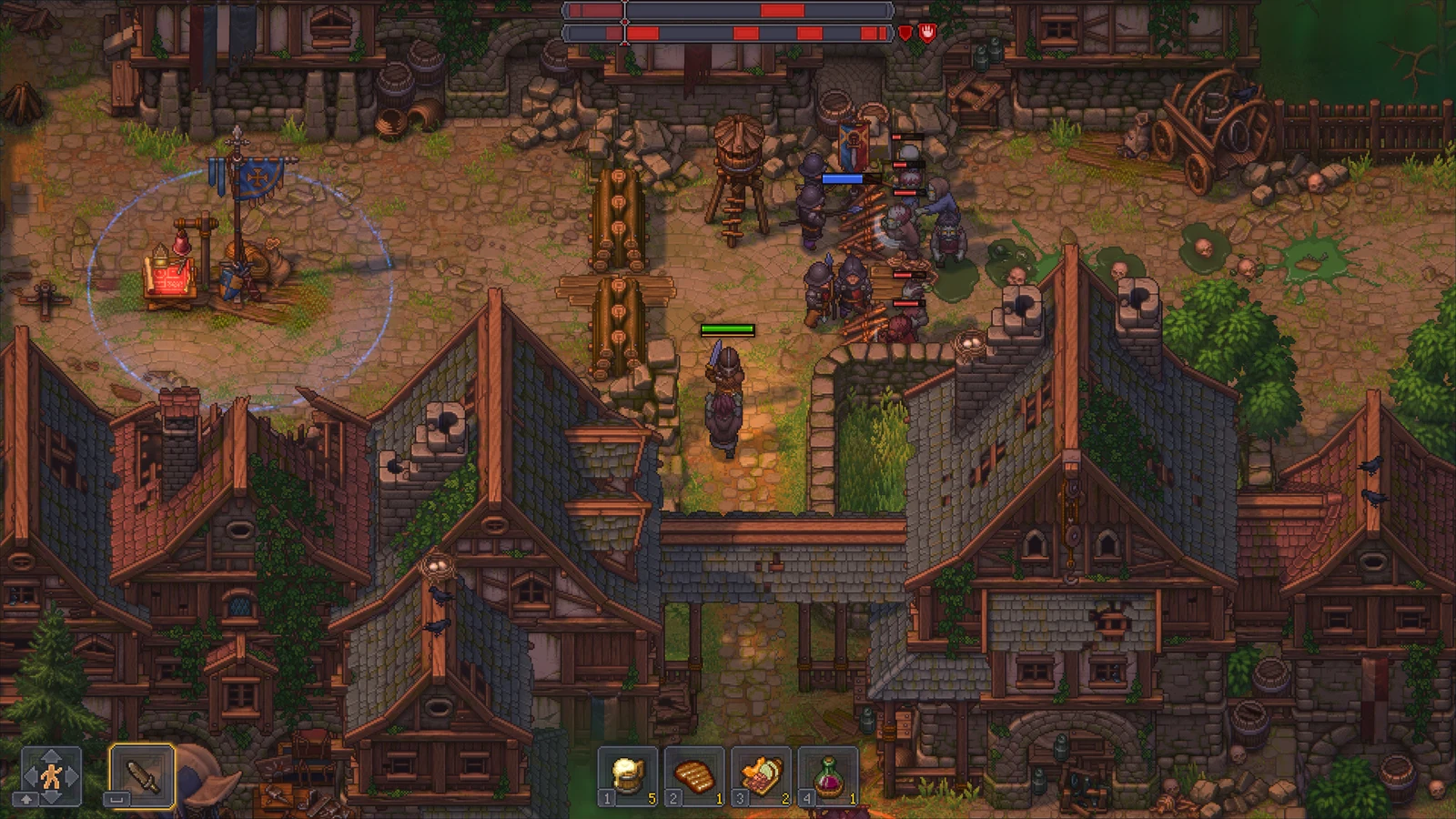
Battle in the Town
View full-size image ↗Official promotional screenshot · © Lazy Bear Games / tinyBuild · Official media kit · Material credits
Why you are fighting
The developers built combat around the story premise: The Town is overrun, so liberating it has to be something you do rather than something that happens off-screen.
They put it bluntly — you get your house, church and graveyard for being a decent person, but the Town has to be taken in battle.
And after the heroics, you are also the one who has to rebuild what you liberated.
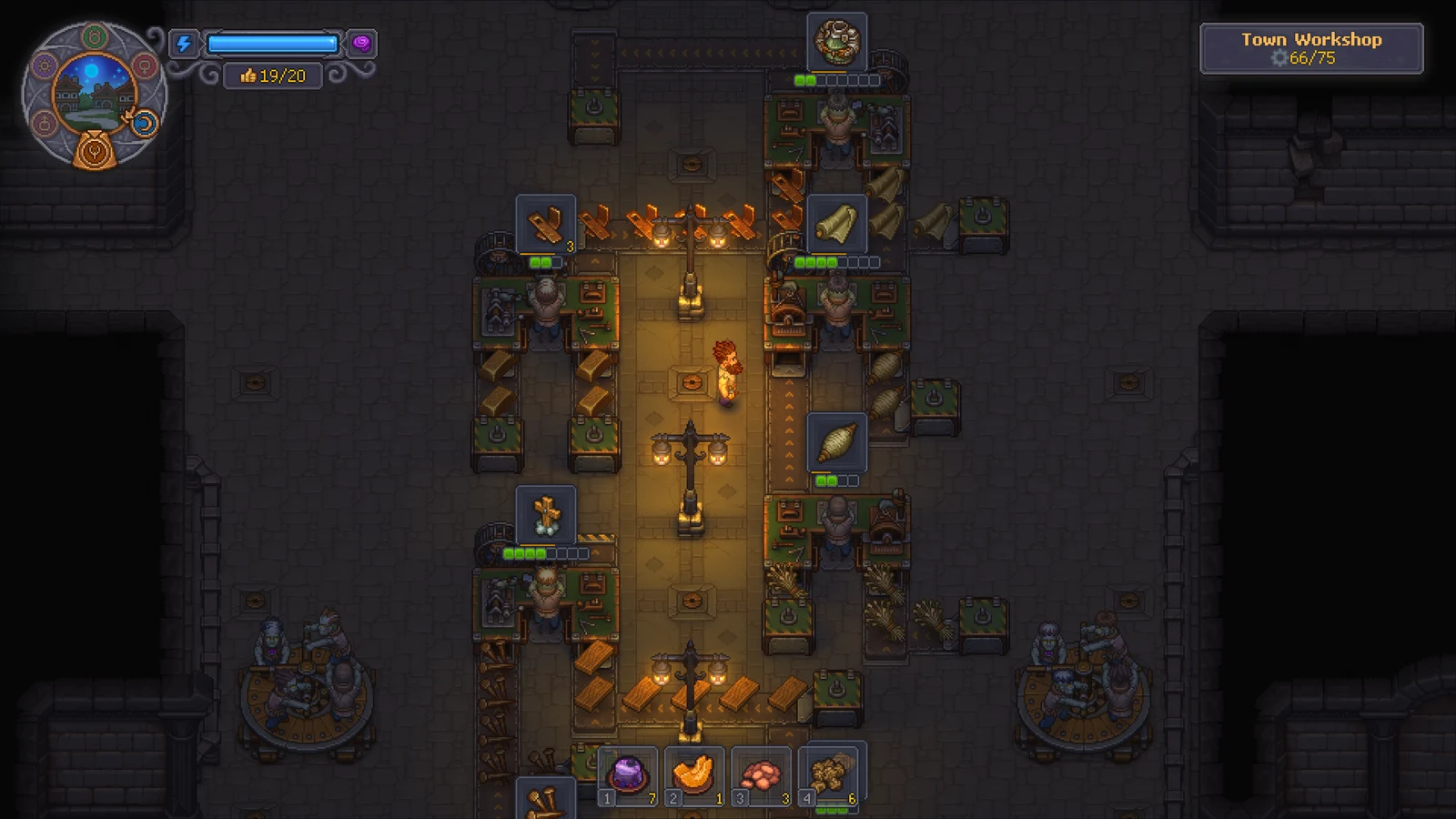
The Town workshop represents the production side of your growing operation. It is not a squad-selection or equipment-recipe screen.
View full-size image ↗Official promotional screenshot · © Lazy Bear Games / tinyBuild · Official media kit · Material credits
Battles are on a weekly timer
Like several of the Keeper's duties, combat is tied to the calendar: city battles are only available on a certain day of the week.
If you want to fight on other days, the sewers beneath the Town are open every day and full of zombies.
The developers also tease something deep beneath the city they call the Sewrena.
Each district is its own battlefield
Fights take place on real streets rather than in dedicated arenas, so different parts of the city become distinct battle maps with their own design and win conditions.
In the battle for the Town Square you hold off waves attacking from every direction.
In the central streets you push forward on multiple fronts and capture control points, and reviewers describe holding every point until the timer ends to win.
Preparation is production
Your advantage is that you already produce quality materials and raise the dead — exactly what a battle needs.
Materials go into barricades and towers that hold enemies back at the approaches to your position, and reviewers note barricades give a squad somewhere to hold instead of fighting in the open.
Zombies go into squads. Equipped with good weapons and armour, they become your comrades-in-arms rather than just workers.
Commanding the fight
You can place squads wherever you like by moving their flags, or raise their banner and lead them in personally.
You fight with a sword or a bow alongside them, and throwing more units at a capture point speeds up the capture.
The developers add that mouse-and-keyboard players can control combat one-handed, which tells you how light the mechanical demands are.
Find a style that works
The design deliberately supports different approaches: all-archer squads, spiked barricades that do the killing for you, or stocking combat potions and holding waves yourself.
Because preparation happens in your own economy, a losing battle is often a production problem rather than a tactics problem.
Make sure the defences are built and the squads are armed before the battle day arrives, since you cannot retry until the next one comes around.
How much fighting is there?
The developers give one hard number: across the course of the game you will lay a little over 4,000 zombies to rest.
That is a campaign-length figure, not a single battle, and it confirms combat is a recurring pillar rather than an occasional set piece.
They are also quick to reassure the squeamish — the zombies are evil, and they are not even real.
Where your soldiers come from
The army is not recruited, it is manufactured. Your zombie workers become fighters once you arm them.
Each zombie develops its own skills, and its perk ceiling is set by the red-skull level of the corpse it was raised from.
That makes corpse corruption a military resource: the more corrupted the body, the better the soldier it can become.
Producing workers beyond your first two requires the Reanimation perk from the Anatomy and Alchemy branch and a dedicated underground room.
The gear behind the squads
The store page lists crafting armour and weapons and training troops among the game's core features.
The developers underline it, saying zombies fight best when equipped with the finest weapons and armour.
Your metal chain therefore feeds the war effort directly, running from scrap and copper through the furnace to the anvil.
Fuel sits underneath all of it, since every smelt draws from the same pool your kitchen and kiln use.
Fighting outside the weekly window
The sewers beneath the city are described as open 6/6 — every day the city battles are not.
They are full of zombies who, as the developers put it, will gladly meet you halfway.
That makes them the place to test a loadout or work off a bad week without waiting on the calendar.
The developers also hint that something called the Sewrena lies deep beneath the Town.
What victory actually changes
Winning a battle usually unlocks a new part of the Town, so combat is the key that opens the map.
Cleared streets then fill with townsfolk and market stalls, converting a battlefield into an economy.
After the liberation comes the rebuilding, which the developers point out is also your job.
So each battle is the first half of a two-part loop rather than an end in itself.
Combat that respects your hands
The developers made a point of keeping inputs light: with mouse and keyboard you can control combat with one hand.
On console the same fight runs through squad positioning and direct melee or bow attacks rather than long input strings.
The PlayStation listing confirms DualSense vibration support, so the haptics are used during those fights.
The emphasis throughout is on preparation and positioning rather than execution speed.
Planning a battle week
Treat the battle day as a deadline and work backwards from it through the rest of the week.
Production days should end with the materials for barricades and towers already stockpiled rather than half-gathered.
Arm and position squads before the day arrives, since a missed attempt costs a full in-game week.
Keep energy and insanity healthy going in, because turning up exhausted wastes the preparation you just made.