Short answer
Mods live on Nexus Mods, which opened a dedicated Graveyard Keeper 2 page with roughly 28 mods in the launch window. There is no Steam Workshop support, so everything is installed manually or through a mod manager, and the series' tooling has historically been built on BepInEx.
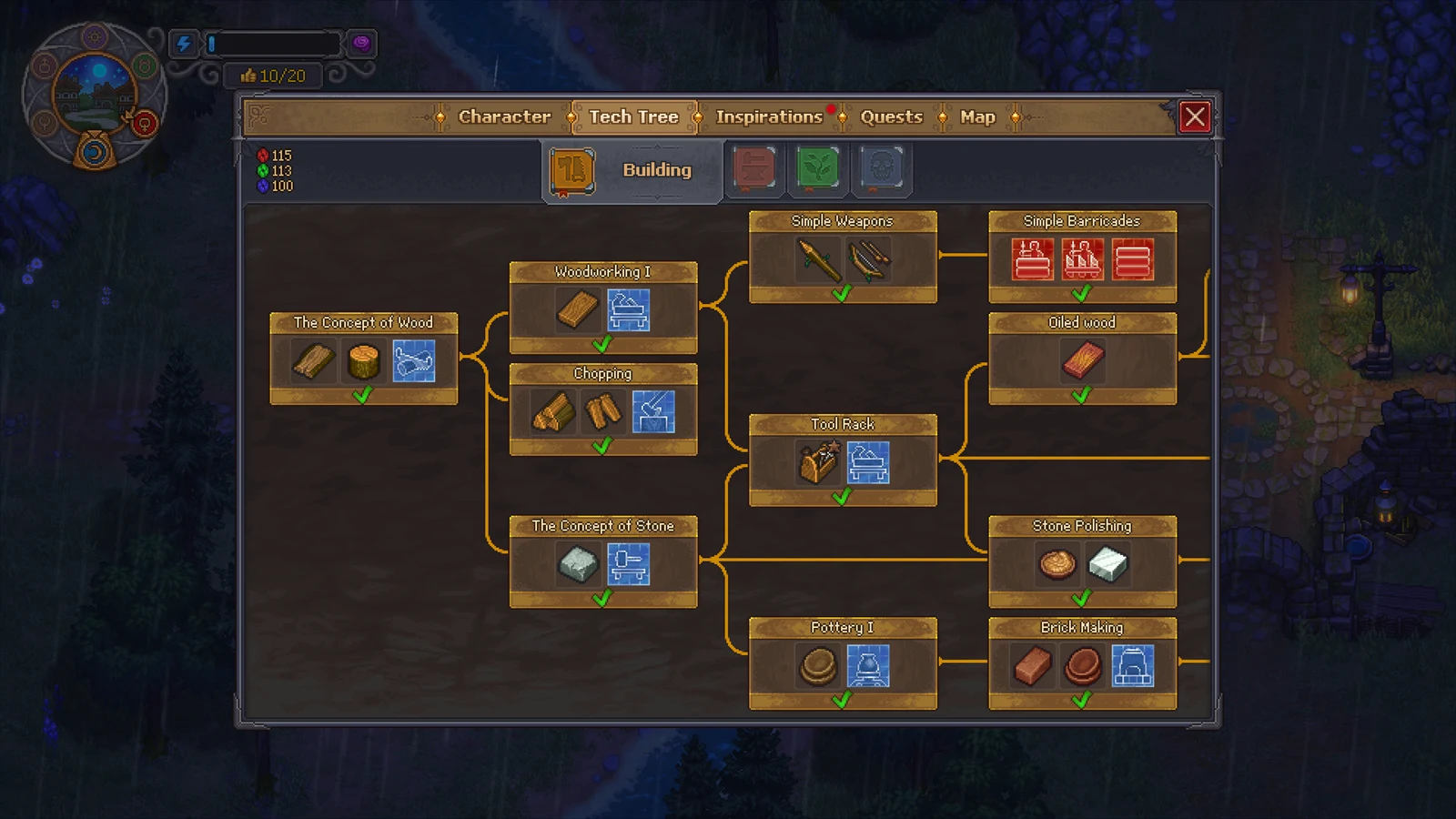
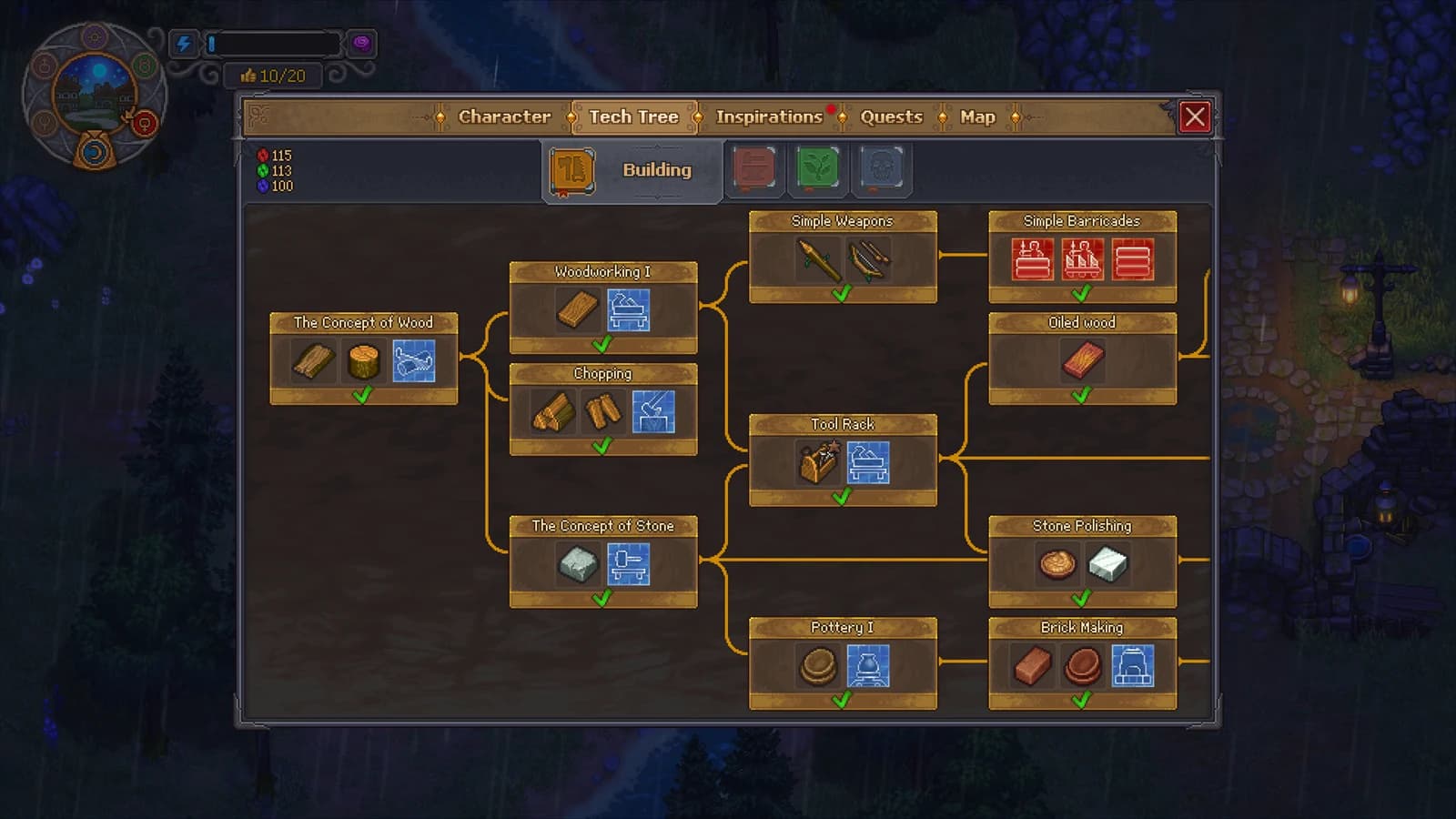
The Building tech tree
View full-size image ↗Official promotional screenshot · © Lazy Bear Games / tinyBuild · Official media kit · Material credits
Where the mods are
Nexus Mods runs the game's dedicated page, and it is the main place community mods are published.
Around 28 mods were available there during the launch window, which is an early but active start.
Because the scene is new, expect the list to change quickly and check upload dates before installing anything.
There is no Steam Workshop
Steam's feature list for the game includes Steam Achievements, Steam Cloud and Family Sharing, but no Workshop entry.
That means no one-click subscribe-and-play. Installation happens outside Steam.
It also means the developers are not curating or hosting mods themselves, so quality and safety are the community's responsibility.
The tooling the series uses
For the first Graveyard Keeper, the modding stack was built on BepInEx, with a pre-configured BepInEx 5 pack you extract into the game directory.
A Vortex extension for the series offers one-click BepInEx installation and handles plugins, patchers, saves and resource swaps automatically, on Windows and Linux or macOS.
The original also had a dedicated mod manager, KeeperLoader. Which of these carry over to the sequel should be taken from each individual mod's own instructions.
Back up your save first
The game supports Steam Cloud, which syncs saves between your devices — convenient, but it also means a broken save can propagate.
Copy your save off before you install anything, especially if you carried progress over from the demo.
Patches during launch week are likely, and each one can break mods that hook into game code.
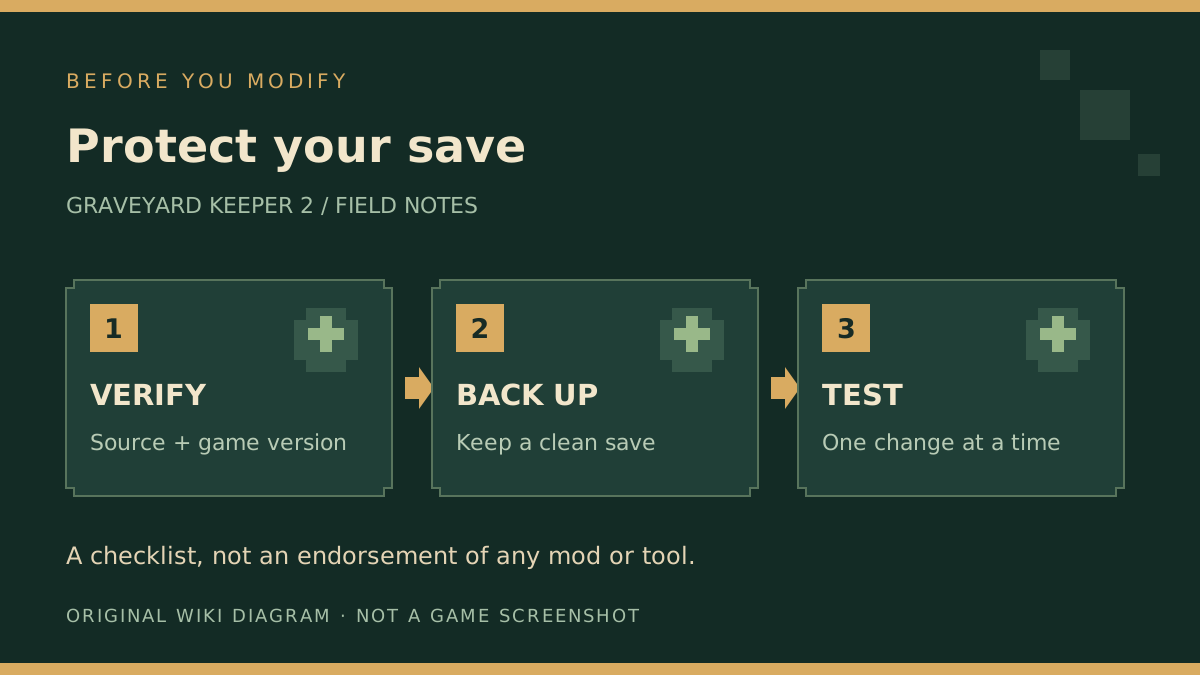
An original compatibility and backup checklist. No third-party mod artwork or unverified modified gameplay is presented as official.
View full-size image ↗Original diagram · Graveyard Keeper 2 Wiki · editorial illustration · Original wiki diagram
Mods are not cheat codes
The game ships with no built-in cheat codes, console commands or developer menu.
That is precisely why cheat-style mods and external trainers exist for the series — they fill a gap the game deliberately leaves.
Be aware that anything hooking into memory carries a higher risk of save corruption than a simple content or quality-of-life mod.
What to expect from the scene
The developers have announced no official mod support or Workshop roadmap; they have only said they hope to keep improving the game based on player feedback.
So the ecosystem will be community-driven for now, and it will churn while the game is being patched.
The safest approach during launch week is a small number of well-maintained mods, re-checked after every game update.
What mods tend to address
The most common requests in this genre are quality-of-life changes: inventory handling, carrying capacity and production speed.
That maps onto the friction players describe in the sequel, where recipes unlock through tech points rather than materials and early production is bottlenecked by fuel.
Some mods instead provide the cheat functionality the game deliberately omits.
Because none of this is officially supported, expect variation in quality and in how well each mod survives patches.
Installing safely
Read each mod's own instructions rather than assuming the first game's process applies to the sequel.
Install one mod at a time so a broken save can be traced to a single change.
Keep a manual copy of your save outside the cloud-synced folder before you start.
After every game update, re-check your mods before loading an important save.
The alternative to modding
If the goal is less repetition rather than more power, the game's own answer is zombie automation.
Workers handle gathering and crafting once equipped, and the developers describe them operating machines in underground factories.
Launch coverage goes further, describing conveyor-belt assembly lines staffed by zombies.
That path is patch-proof in a way that third-party tooling is not.
Before you install anything
Check whether your save came from the demo, since demo progress carries into the full game and is easy to lose to a bad install.
Note that the game is single-player and offline-capable, so mods do not carry online-cheating consequences — only save risk.
There are no achievements-related warnings published by the developers, but Steam Achievements are supported, so consider that before modifying progression.
And confirm the mod's upload date against the game's patch history.
Where the scene is likely to go
The first game accumulated a substantial mod library over years, which suggests the sequel's will grow well past its launch-window count.
A dedicated Nexus page from day one is a good sign that the infrastructure is already in place.
Without a Workshop, discovery will stay centralised on Nexus rather than inside the game.
Expect the early weeks to favour quality-of-life fixes, with larger content mods arriving once the tooling settles.
Mods versus the game's own tools
Two of the game's most-modded frustrations in this genre already have in-game answers worth trying first.
Slow production is addressed by zombie workers, who take over gathering and crafting once equipped with a tool.
Locked recipes are addressed by spending tech points, since hoarding materials never reveals anything on its own.
If those systems still leave you wanting, that is the point at which a mod is solving a real problem rather than a misunderstanding.
A realistic expectation for launch week
A game released on September 22, 2026 will be patched frequently in its first weeks.
Every patch is a chance for a code-hooking mod to break, sometimes silently.
The lowest-risk approach is a short list of well-maintained mods plus a manual save backup.
If you would rather not manage that, waiting a few weeks costs nothing and avoids most of the breakage.
Console players
Mods are a PC matter here: the PS5, Xbox and Nintendo versions have no mod support.
Nothing about the console experience depends on it, since the game is fully single-player and offline-capable.
If modding matters to you, that is a reason to buy on PC — and remember demo saves do not move between platforms.
Decide before you sink hours into a demo save on the wrong console.